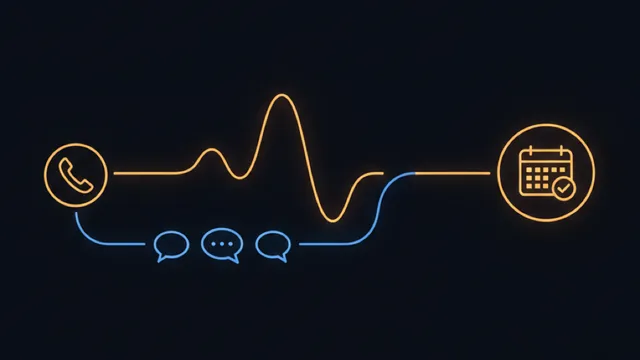

Speed to Lead
How fast do Australian businesses reply to enquiries? We tested 115
We sent after-hours enquiries to 115 Australian businesses that advertise for leads. Only 2% had a person reply within five minutes.
A missed call text back sends an automatic SMS to anyone whose call you miss. Here is what it does well, where it falls short and whether it is worth it.
A missed call text back is an automatic SMS sent to someone whose call you missed. When a call to your business rings out, goes to voicemail or hits a busy line, the caller gets a text within seconds saying you saw the call and asking what they need. For most service businesses it is worth setting up, as long as someone answers the replies quickly, because the text on its own only buys you a few minutes.
Most CRMs and business phone systems can send one. In GoHighLevel, for example, it is a workflow that can be set to run when an incoming call ends busy, unanswered or in voicemail. The text usually goes out from your business number, so the caller’s reply comes back into the same conversation.
Someone who rings a plumber or an electrician usually has a few other numbers ready. If nobody answers, ringing the next business is easier than leaving a voicemail and waiting to hear back. Unless someone checks the call log, nobody ever calls them back.
Missed calls also pile up at the worst times. You are on a roof or with another client, and calls that come in after hours often sit until the next morning. The gap between an enquiry arriving and someone replying decides a lot of jobs, and a missed call with no follow-up leaves that gap open until somebody remembers to ring back.
Its main job is to catch the caller before they dial the next business. A text that arrives while they still have the phone in their hand tells them the call was seen, and answering it takes less effort than explaining the job to someone new.
It also suits people who cannot talk right then, because someone ringing from work can reply when they get a minute. And every missed call becomes a contact with a conversation attached, instead of a number nobody follows up.
Sending the text is the easy part. Say it goes out at 7:01pm on a Thursday, and at 7:03pm the caller writes back: “Our hot water has stopped working, can someone come out tomorrow?” In most setups that reply lands in an app or a shared inbox that nobody watches at night. Someone reads it at 8:30 the next morning, and by then the caller has probably booked whoever picked up the phone.
A template text with nobody handling the reply only delays the loss. The caller told you the problem and when they needed it fixed, and the job still went elsewhere, just a little later than it would have without the text.
Some setups make it worse with a second canned message, such as “Thanks, someone will be in touch soon.” That tells the caller nobody has read what they wrote. The reply needs a real answer within minutes, while they are still waiting for one.
A setup that wins jobs gets three things right.
A template cannot do the second one. An AI sales agent that replies within minutes can handle that whole conversation: it qualifies the caller, books the job into your calendar and hands it to your team with the conversation attached.
ACMA notes that texts sent under a business name instead of a phone number generally cannot receive replies, which defeats the purpose of a text back. Since 1 July 2026, texts sent under a business name that has not been registered also show as “Unverified”, and ACMA warns that people may ignore or delete them. Sending from a phone number the caller can reply to avoids both problems.
Some callers need to talk now. Someone with a burst pipe or no power wants a person on the line, and a text asking what they need can feel slow. Bigger jobs often need a proper conversation before anyone books, and some callers would simply rather talk than type.
For those calls, answering beats any text. A Voice AI receptionist answers every call, day or night, asks the questions your team would ask and books the job into your calendar. Voice AI and SMS suit different leads, and plenty of businesses run both, so the phone gets answered and any call that still slips through gets a text.
A missed call text back is an automatic SMS that goes to someone whose call you missed, asking what they need while they are still deciding who to ring next. It is worth setting up, but the text itself is the easy part. You win the job by answering the reply within minutes, qualifying the caller and booking them in, including after hours. If the caller needs to talk straight away, answering the call works better.
To see how many of your own missed calls get a reply in time, book a free revenue engine audit.
Your phone system or CRM watches for incoming calls that end unanswered, busy or in voicemail. When one does, it texts the caller within seconds, usually from your business number, saying you missed their call and asking what they need. Their reply comes back to the same number, ready for someone to answer.
Yes, as long as someone answers the replies within minutes. The text gives a caller a reason not to ring the next business straight away, but a reply that sits until the next morning loses the job just the same. Set it up together with a plan for who handles the conversation, especially after hours.
Name the business, say you missed their call, and ask one easy question about what they need, such as what the job is. Keep it short enough to read on a lock screen, leave links out, and send it from a number they can reply to.
We sent after-hours enquiries to 115 Australian businesses that advertise for leads. Only 2% had a person reply within five minutes.
Most leads go cold in two places: the first few minutes after they arrive and the first week of follow-up. Here is where they go and how to close both gaps.
Voice AI and SMS solve different parts of the lead follow-up problem in Australia. Here is how each channel fits into the sequence, and when you need both.
We map where your leads go quiet, then show you the conversations an agent would have had. Thirty minutes, no obligation.